
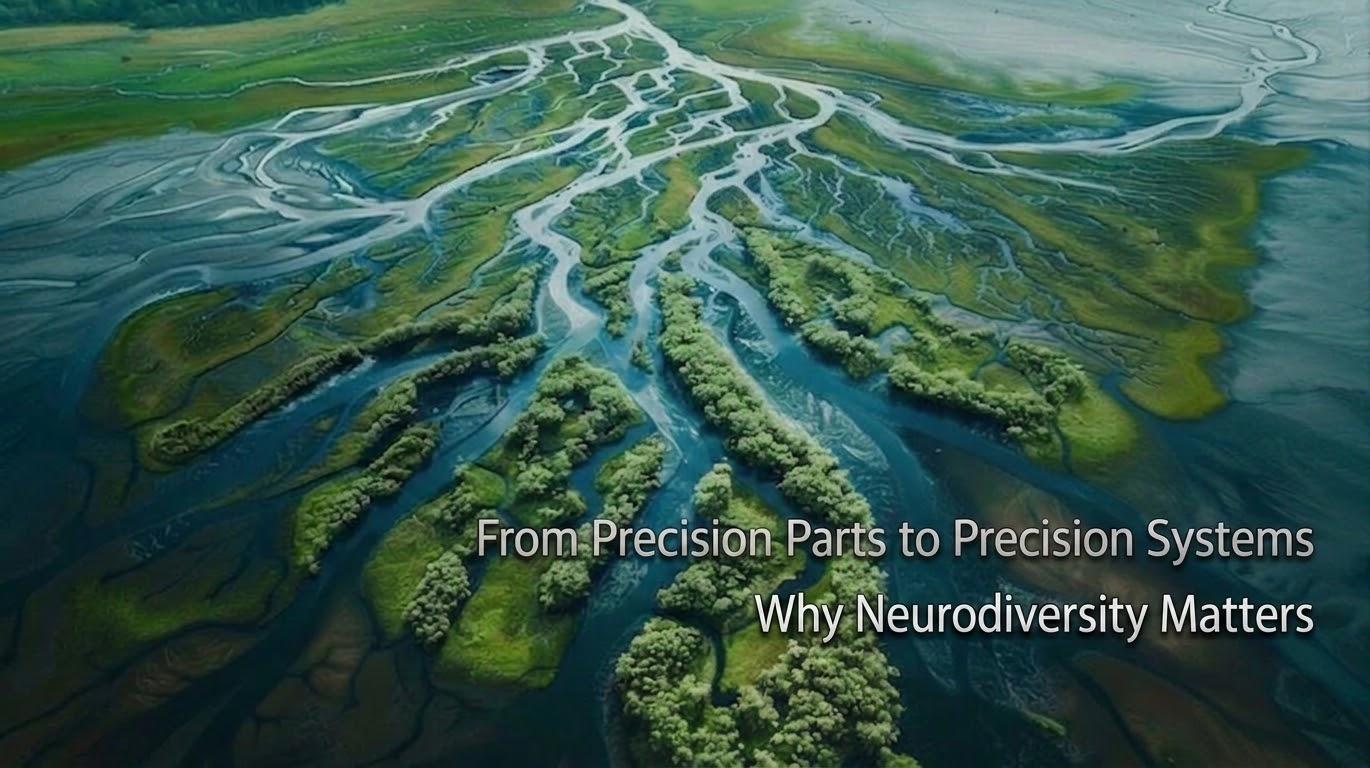
Personalized medicine keeps almost arriving. Here is the level it has been missing — and why the science of neurodiversity is where it gets found.
There is an adventure science set aside almost before it began. The method that made modern medicine powerful also told it what to ignore: anything that would not resolve into clean, isolable cause-and-effect was, by definition, not yet evidence. A variable had to hold still — separable, controllable, reproducible — before it could be believed. And the factors that matter most for how an actual person holds together, breaks down, and recovers would not hold still. Personality, stress, energy: each one proliferates, each manifesting in a dozen directions at once, each one both cause and consequence of everything around it. They fed back on themselves; they refused to sit on one side of an equals sign. So they were set aside — not judged unimportant so much as intractable, the kind of thing that could never deliver the causal proof the paradigm demanded. They pointed in too many directions to point at anything. And here a substitution took hold that still governs how the field speaks: to say there is no evidence for something came to mean, in practice, that there is no demonstrated direct cause, as if those were the same claim. They are not. Evidence is abundant; what is scarce is the single clean arrow from one isolated variable to one isolated outcome. To mistake the missing arrow for missing evidence is what keeps a full record looking empty.
What has changed is not the data. It is the lens. A nonlinear, systems view is built precisely for variables that proliferate, feed back, and refuse to be isolated — it reads dynamics, coupling, and emergence rather than single arrows of causation. Turn that lens back on the factors medicine bracketed, and you find the evidence was never actually missing. It is there in spades, scattered across thousands of studies on stress, regulation, personality, and energy — measured, replicated, published, and then left unassembled, because no one had a way to put it together. The new paradigm of health does not have to be conjured from nothing. Most of the work is already done. What it needs is a way to read the existing record as a system rather than as a pile of unrelated effects.
Nowhere is the cost of leaving that record unassembled clearer than in the promise of personalized medicine, which for more than two decades has been one of the most ambitious goals in healthcare. The vision is simple: instead of treating patients against population averages, care would be tailored to each person’s particular biology, physiology, and life. The honest status report is that we are there for a handful of diseases, but not yet for most of human health. In oncology, genetic profiling now guides real treatment decisions. Whole-genome sequencing can resolve some rare disorders. Pharmacogenomics can flag how certain patients will metabolize certain drugs. These are genuine wins, and any account of personalization that waves them away has disqualified itself.
And yet the conditions that account for most of the suffering and most of the cost — autism, depression, anxiety, autoimmune disease, chronic pain, obesity, cardiovascular disease, dementia — remain stubbornly resistant to truly individualized care. This is the field’s live puzzle, and I think it has a clean answer that the field keeps circling without landing on. Medicine has become very good at identifying biological parts and has struggled to describe biological systems. Genes, biomarkers, and molecular pathways reveal pieces. They do not explain why two people with nearly identical genetics diverge into different outcomes, or why a single person crosses between health and illness across the seasons of a life. Parts do not move like that. Systems do.
So begin with what personalization actually is, because the answer follows from the definition. To personalize health is to say something true about this person’s dynamics: how they regulate, how they predict, how they spend a finite budget of adaptive capacity, how much load they can carry before something gives. And what it pays with is energy: allostasis is, at bottom, anticipatory energy regulation — the body forecasting demand and provisioning against it before the bill comes due — and the cell’s energetic machinery, mitochondria included, is where that provisioning is finally met or missed. Energy is the currency the trunk traffics in; to read the trunk is to read how a person raises, banks, and spends it under changing loads. These are not static facts about a person. They are processes running in real time, at the timescale on which an organism is continuously anticipating demand and paying against it — the allostatic timescale, the scale of minutes and days and years over which the body adapts. Personalization is a regulatory-dynamics problem before it is anything else. And regulatory dynamics is exactly what the stress sciences read. The claim that personalized health would always come from stress models is therefore neither a loyalty nor a preference. It is a statement about levels of analysis: the science of an individual’s regulation simply is the science that can individuate.

This is why genomics, for all its real victories, was never going to deliver personalization on its own, and the clearest way I know to say it is the image of a tree. The genes are the root tips — the finest, most distal ramifications, enormously many, each one tiny, each one far from where the organism’s state is integrated. The trunk is that integrated regulatory state, the single living column through which everything must pass. The canopy is phenotype and behavior, the part we can see. You cannot predict the canopy by cataloging the root tips, because everything the roots carry is integrated and transformed at the trunk before it ever reaches the light. The polygenic signal is real; it is also, by the time it reaches the level that matters in a clinic, integrated beyond recovery. Genomics returns something valuable — population-distributional risk, a probability, a position on a curve. But a position on a curve is the parametric view: it tells you where a person sits relative to everyone else along a pre-chosen axis. It hands you back the average when what you needed was the configuration. More root tips do not assemble into a trunk. Genetics is not the wrong tree. It is too distal from the trunk, and personalization has to read the trunk.
What has changed, and why the moment is now, is that the trunk is becoming readable. The instruments for watching regulation unfold in real time have arrived, almost without anyone noticing, as the important ones. Wearable sensors continuously track heart rate variability, sleep, movement, and physiological load. Multi-omics platforms read genes, proteins, metabolites, and microbes in the same window. Machine learning can integrate across scales that were uncombinable a decade ago. The questions a systems view wants to ask are, for the first time, measurable: how is this person’s regulatory architecture organized, how does their body allocate energy under strain, which physiological systems are compensating for which others, what makes one person resilient and another vulnerable under the same conditions, how do developmental history and environment and biology braid together over time. This is the frontier the field has started calling precision systems medicine — the shift from asking which gene caused this to asking how this whole brain-body-environment system is organized as a living, adaptive thing.
But I want to sharpen that frontier, because precision systems medicine, as usually told, still carries one quiet assumption that will keep it from arriving — and sharpening it is where the science of neurodiversity stops being a special interest and becomes the engine. The assumption is that you build personalization from the center: model the typical organism first, get the average case right, then treat individual variation as noise to correct around the model. The science of neurodiversity inverts this. Personalized health comes from the periphery, because the periphery is precisely where the curve model visibly fails. At the edge of the distribution, the heterogeneity is so plainly architectural — so obviously a matter of differently organized regulation rather than more-or-less of one shared quantity — that the deviation framing breaks in your hands. You cannot describe an autistic regulatory profile as a typical profile with the dial turned down without losing the phenomenon entirely. The periphery forces you to the configuration level because nothing else works there.
That is also the answer to the puzzle we started with. The common, costly conditions resist individualized care not because we lack enough biomarkers but because they are architectural, and architecture cannot be individuated by locating someone more precisely on a curve. The hardest case for the old model turns out to be the generative case for the new one. So build the apparatus that reads configuration on the domain that demanded it — the domain where parametric description was never adequate and everyone half-knew it — and the apparatus generalizes. It generalizes inward, toward the center, because the statistically dominant, institutionally default neurotype is, on this view, not a baseline from which others deviate. It is one more configuration, distinguished by being common and by having built the institutions. Once you can read the regulatory configuration at all, the center is simply another case you can now read. Neurodiversity is not a corner of medicine asking for accommodation. It is the wedge that cracks medicine open to configuration-level reading in the first place.
The vocabulary follows the same shape, and this matters for how the framework should arrive. Regulatory information, architectural heterogeneity, regulatory bandwidth, stress incoherence — these terms do not overwrite allostatic load, or enhanced perceptual functioning, or any structure clinicians already work with. They sit on top and add observables: things you can now name, track, and increasingly measure where before there was only narrative. The framework subtracts nothing from existing practice; it supplies the description layer that practice was missing. That is an invitation, not an indictment, and it should be offered as one.
I will hold one honesty against my own argument, because it is load-bearing. “Additive, nothing lost” is the right posture, but the move from parametric to architectural is not additive in its content — it changes the unit of analysis, and that change is the entire point. The risk of a too-gentle additive pitch is that the whole frame gets absorbed as optional flavor, a nicer way of talking, while the commitment that does the work quietly evaporates. So the form I want is additive in invitation and non-negotiable in commitment: nothing is taken from the clinician’s toolkit, and yet where health is genuinely defined, it relocates — from a position on a population curve to the shape of an individual’s regulation. Health ceases to be the absence of disease and becomes the capacity of a particular, configured system to adapt, predict, regulate, and recover under changing conditions.
Which is why the field’s framing question — are we there yet? — is not quite the right one. The question is not whether personalized medicine is possible. The instruments are arriving and the systems view is already half-built. The question is whether medicine will move to the level where persons actually differ from one another, and the science of neurodiversity is where that level was first forced into the open. The future of medicine may not be primarily genomic. It may be ecological, dynamic, and deeply personal — concerned less with what a person is made of than with how their whole system is organized to live. Lead with that level. The rest follows on its own.
The Evolutionary Stress Framework is a conceptual lens for thinking about regulation, heterogeneity, and health — not a diagnostic tool or a source of medical advice. Nothing here is a clinical claim about any individual.
More on “personality”, science and the ESF

Leave a Reply