
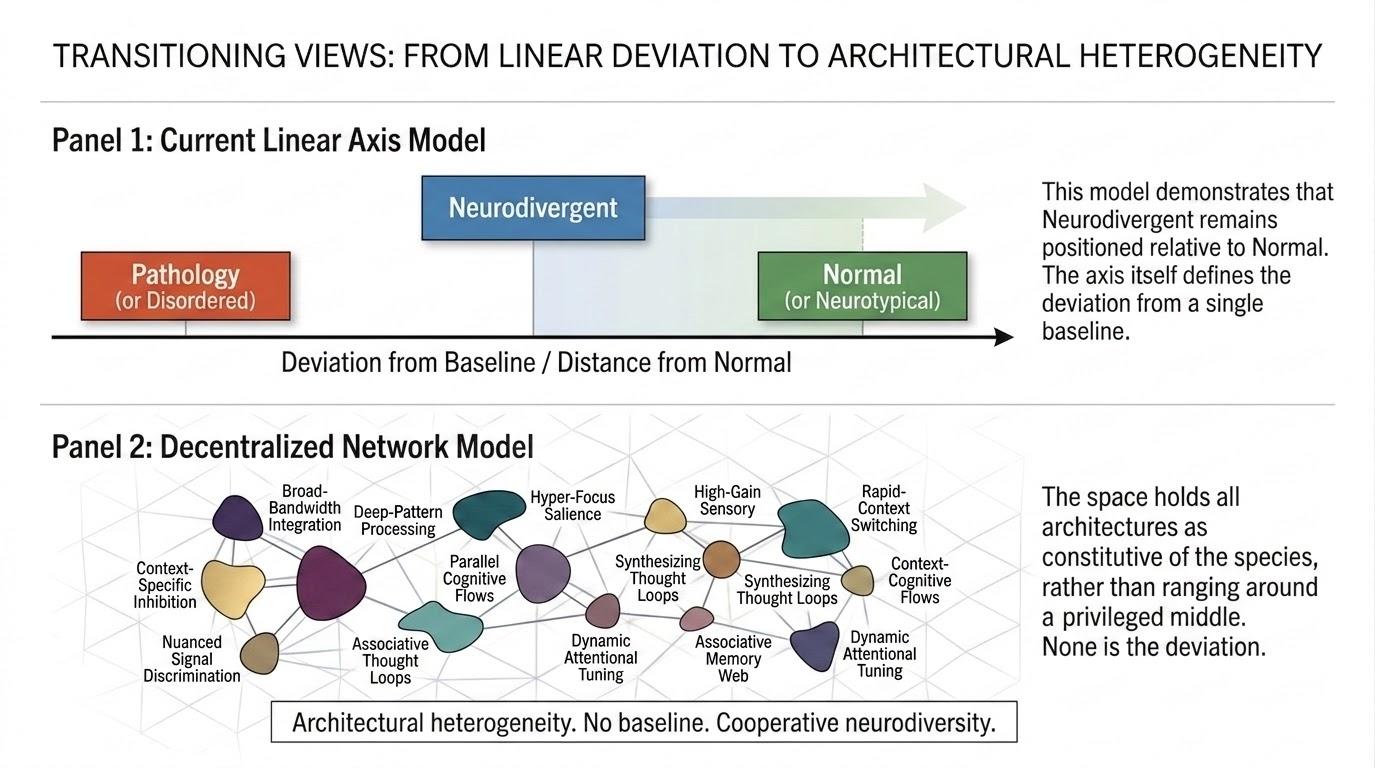
The medical model says the problem is in the body. The social model says the problem is in the environment. Neurodivergent people are asked to choose, and most of us can’t comfortably pick either.
The medical model frames our architecture as defective. The social model frames our cost as purely environmental — which is partly true, often the larger part, but it erases the regulatory reality of running a high-gain nervous system in any environment. So neurodiversity gets carved out as a third option. Not disordered. Not normal. Just different.
That carve-out felt like liberation. For a lot of us, it was. But look at what it actually does to the structure.
It creates a designated holding pen between pathology and normal — and the holding pen preserves the very thing that produced the stigma in the first place. Because as long as “normal” remains the implicit reference architecture, everything else is still a deviation from it. “Neurodivergent” becomes the polite name for deviant-but-we’re-not-saying-deviant.
The stigma doesn’t dissolve. It migrates.
This is why the social-medical dichotomy can’t actually liberate us, even when it’s working at its best. Even a fully realized social-model accommodation regime still operates inside a frame where “the disabled” exist as a recognized category requiring accommodation from the implicitly-normal majority. The category persists. The hidden average persists. The accommodation is real and matters. But the architectural framing — we are different kinds of system, all of which are part of how the species works — that’s not a social-model claim. The social model, however well-extended, can’t quite hold it.
What dissolves the structure isn’t a third box. It’s removing the reference architecture entirely.
Cooperative neurodiversity isn’t “we’re different but equal.” It’s there is no baseline. There is a portfolio of architectures, each with costs, each with contributions, each adaptive under different conditions. The species is constituted by the heterogeneity, not deviated from a baseline by it. The high-gain regulatory profiles associated with autism, ADHD, sensory processing differences carry real metabolic costs and narrower margins. They also carry forms of pattern recognition, integration, and perceptual fidelity the rest of the architectural portfolio cannot produce. Cost and contribution share a mechanism. Neither is the deviation. Both are how the species works.
This is structurally different from “neurodiversity” as it’s commonly used. It removes the axis the boxes sit on.
I don’t think the disability community is wrong to keep extending the social model. The extensions are doing real work, and the medical model still needs the pushback. But I think the frustration a lot of neurodivergent people feel — that liberation came with conditions we couldn’t quite name — is structurally correct. The dichotomy didn’t dissolve stigma. It migrated it. The between-box was always going to be unstable, because it was constructed on the same axis as the boxes it was meant to escape.
The way out isn’t choosing better between medical and social. It’s stepping off the axis they share.
That’s a longer essay. Coming soon.
This is part of an ongoing argument I’m developing through the Center for Adaptive Stress and the Evolutionary Stress Framework. The first peer-reviewed piece is in Autism in Adulthood*: “Toward an Emergent Paradigm for Neurodiversity and Health” (Hogenkamp, Sanghavi & Natri, 2026).*

Leave a Reply