
Uncategorized
-
Not a Shift, an Opening

Sep 20, 2026 · @Lori Hogenkamp Why I no longer state my purpose as a paradigm shift The word I stopped using For years I described what I was building (sometimes what we were building) as a paradigm shift, and others described it that way too. The phrase is everywhere. Sequencing the human genome was… Continue reading
-
The Wiring Diagram Is the Finding

On the largest protein map ever built for autism — and the question it makes unavoidable On 27 August, a UCSF-led team published in Science the largest map of molecular interactions ever assembled for autism. Alison Singer, president of the Autism Science Foundation, called it a watershed moment. She is right. I want to say… Continue reading
-
The Brain Thinks Through the Body
How the mind–body split hides solutions, from autism to aging An ESF perspective. This essay describes a conceptual framework, not medical guidance. Nothing here is a substitute for clinical evaluation, and none of it claims to reverse or treat any neurological condition. I. Two rooms, one problem Picture two rooms. In the first, a nine-year-old… Continue reading
-
The Autism Split Debate Is Really an Argument About Who Deserves What
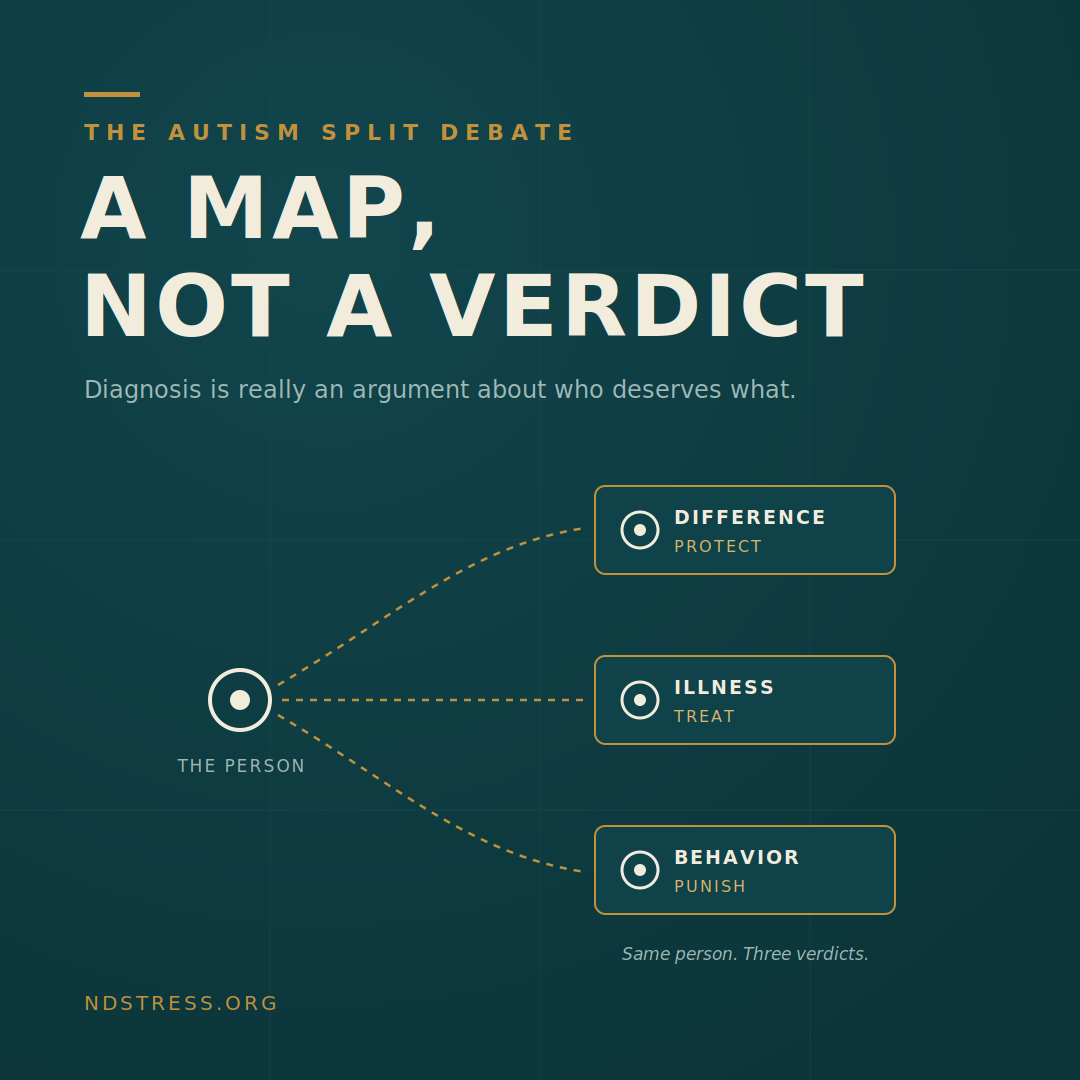
By Lori Hogenkamp There is an argument missing from the debate over whether the autism spectrum should be split, and I want to make it — but I need you to hold your judgment for a few paragraphs, because it starts somewhere uncomfortable. You know the debate. Prominent researchers, most recently Uta Frith in an… Continue reading
-
One System, Many Diagnoses

Autistic adults often carry a stack of “comorbidities,” treated as separate problems by separate specialists. This piece makes a different case: one regulatory system with no margin left, surfacing in several places at once. Not a fifth prescription — one system, given room after carrying too much for too long. Continue reading
-
Reading the Body of a Neurotype
Most of the case for neurodiversity has been made in the register of the mind — ways of thinking, attending, communicating. But a neurotype was never only cognitive. In Toward an Emergent Paradigm I named its biological face — the bio-neurotype — as “potentially measurable.” My new Psychoneuroendocrinology paper is the measurement. This piece connects… Continue reading
-
What Regulatory Bandwidth Makes Visible

We talk about a person’s capacity to handle stress as if it were a single dial — high or low, fixed, theirs. My new paper in Psychoneuroendocrinology says otherwise. Regulatory bandwidth is the present capacity of the body’s coupled stress systems, distributed across many channels, shaped by how a system is organized rather than where… Continue reading
-
Who Decides When a Stress Difference Is a Disorder?
A paper about maternal stress hormones and autism is almost guaranteed to become a story about whether stress during pregnancy causes autism. That is not what the evidence shows. But a recent review connecting maternal stress physiology, placental regulation, and autism-related development is still worth reading closely — not for its conclusions, but because it… Continue reading
-
The Missing Layer in Autism’s Energy Revolution
Mitochondria, metabolism, and autonomic regulation are reshaping autism neuroscience. But energy is fuel — and fuel alone can’t explain why the same challenge lands so differently in different nervous systems. We’re missing a layer. Consider three contrasts among autistic nervous systems under load. One child loses access to speech and daily-living skills during an illness… Continue reading
-
Acknowledged, Not Resolved
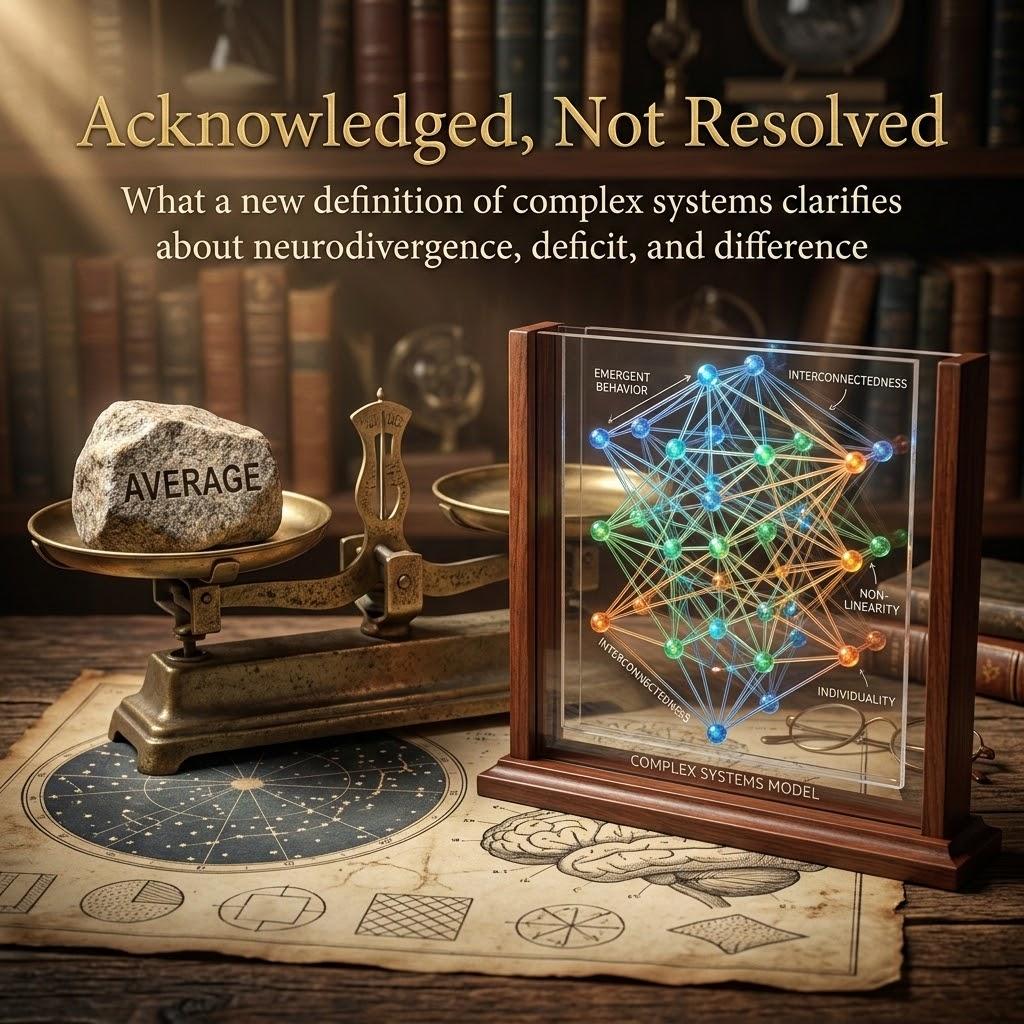
What a new definition of complex systems clarifies about neurodivergence, deficit, and difference Dave Snowden has published a definition of a complex system (Snowden, 2026). It is worth reading on its own terms. It is careful to be a definition rather than an explanation — rarer than it sounds — and it makes a set… Continue reading
About
Recent Posts
- What is Linear vs Nonlinear Science?
- The Biopsychosocial-Nutritional Model
- Why Medicine Needs Neurodiversity and Systems Science