
By Lori Hogenkamp
There is an argument missing from the debate over whether the autism spectrum should be split, and I want to make it — but I need you to hold your judgment for a few paragraphs, because it starts somewhere uncomfortable.
You know the debate. Prominent researchers, most recently Uta Frith in an August editorial in Psychological Medicine, argue that the spectrum has grown too broad — that a “strictly pruned” category would serve science and services better, and that some people now diagnosed autistic have been, in effect, misdiagnosed. They have another condition, the argument goes, or no condition at all, and calling it autism obscures the people who need the label most.
Set aside for a moment whether that’s right. Notice instead what the claim is: a claim about misdiagnosis. And then notice who has been making misdiagnosis claims, in the opposite direction, for decades.
The misdiagnosis argument has been here all along
Long before anyone worried the spectrum was too big, autistic women — and others who didn’t match the textbook presentation — were telling us they had spent decades being sorted into the wrong categories. Anxiety. Depression. Bipolar disorder. Schizophrenia. And above all, borderline personality disorder — a label that, whatever its clinical intent, has functioned in practice as medicine’s way of saying difficult woman. Before any of those, many got no diagnosis at all, just a reputation: dramatic, oversensitive, manipulative, lazy, too much.
The clinical literature eventually caught up with what these women had been saying: late-diagnosed autistic adults, especially women, very commonly arrive at an autism diagnosis carrying a stack of prior psychiatric labels, many of which never quite fit and none of which made their lives make sense.
Now the split debate flips the deck. The same population — adults, disproportionately women, diagnosed later in life — is being recast as the problem. The suggestion, sometimes gentle and sometimes not, is that they are misdiagnosed in the other direction: that they have claimed a “difference” when what they really have is a disorder that should be treated, or a personality that should be — well, no one finishes that sentence out loud.
So here is the missing argument. If the same people, with the same presentations, can be officially sorted as bad character in one decade, mental illness in another, and neurological difference in a third — and if we are now debating sorting them back — then our categories are not tracking anything stable about the people. They are tracking something else. The question is what.
The three slots
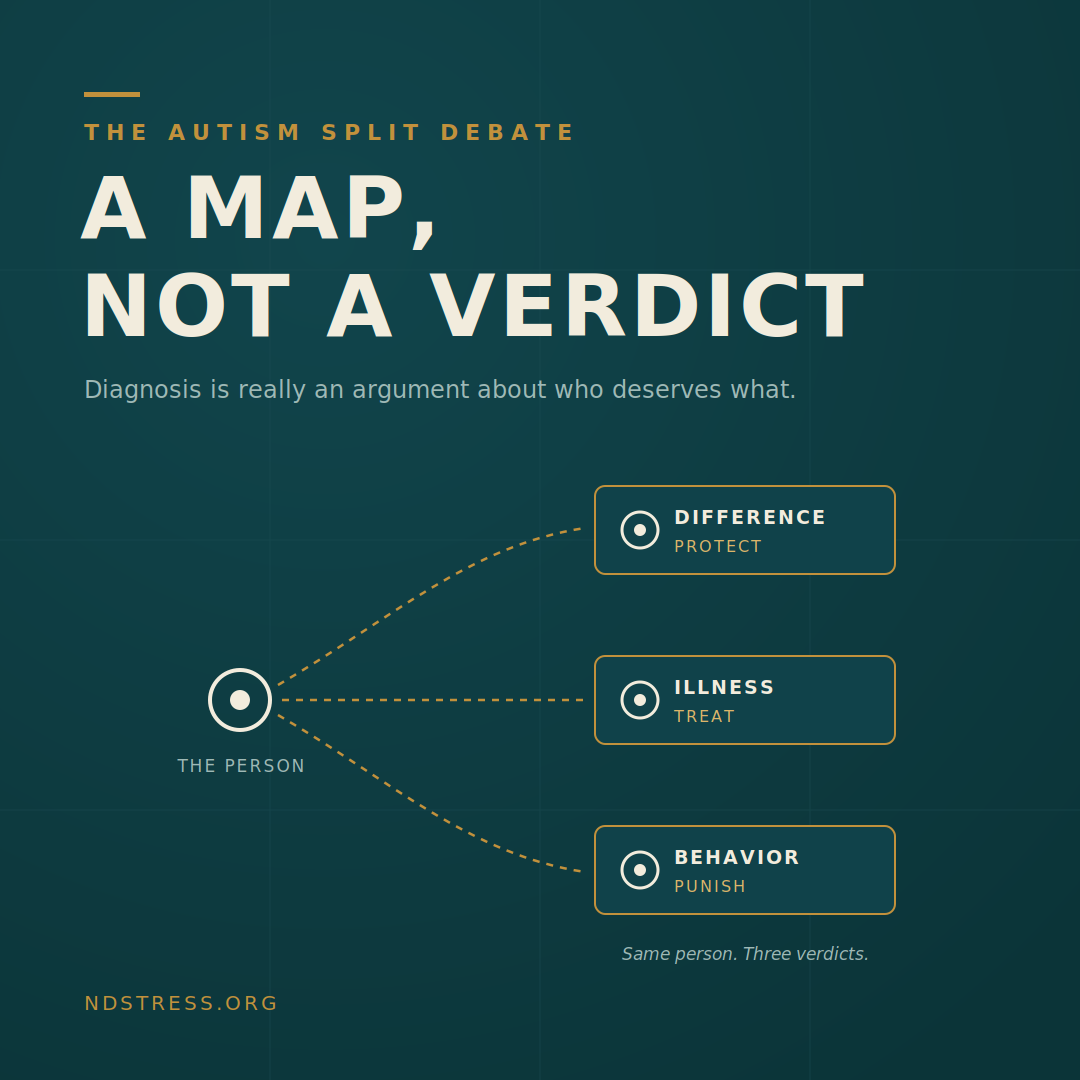
I think they are tracking a verdict. Specifically, a verdict about which of three social responses a person deserves. Our culture — and the medicine embedded in it — runs on a sorting machine with exactly three slots:
Difference deserves protection. Disorder deserves treatment. Behavior deserves punishment.
That’s the whole machine. If your struggle is a difference, you get accommodations and civil rights. If it’s a disorder, you get medication, therapy, and sympathy — conditional on compliance. And if it’s neither — if no one can produce a certificate — then it’s behavior, and behavior gets consequences: discipline, bullying, firing, ostracism, moral judgment. You either get a pass or you get punished, because in a social order built on rewards and consequences, those are the only tools anyone has.
Once you see the three slots, the entire diagnostic history of marginalized and atypical people reads differently. The women misdiagnosed with borderline personality disorder weren’t just given the wrong label; they were assigned to the wrong slot — the one closest to punishment, the one where treatment is offered grudgingly and blame is never fully lifted. The fight for autism diagnoses in adulthood was never really a fight over a word. It was a fight to be moved from the punishment slot to the protection slot. And the current backlash — the worry that too many people are “claiming” autism — is, at bottom, a worry that too many passes are being issued. That people are escaping consequences they deserve.
No one says it that way. But listen to the language of the debate — diagnosis-seeking, over-identification, diluting the category, taking resources — and ask what work those phrases are doing. They are gatekeeping a pass.
Why the machine exists
The sorting machine isn’t anyone’s malice. It’s the shadow of a scientific model.
Modern medicine was built on a spectacular success story: find the specific cause, and you can cure the specific disease. One germ, one lesion, one gene — one fix. Where that model applies, it is one of humanity’s greatest achievements. But its jurisdiction was always narrower than we admitted. It works for conditions with a single dominant cause. It has never worked well for the conditions that now make up most of human suffering: chronic illness, trauma, developmental variation, mental health, aging — everything that emerges from many interacting causes across a whole life in a whole body in a whole environment.
Here’s the problem: whatever the specific-cause model couldn’t claim didn’t get a better model. It got the default. And the default, in a punishment-and-reward culture, is the behavior slot. Can’t find the lesion? Then it must be character. Try harder. Comply. Be normal, and you’ll be rewarded with belonging, employment, and the health that comes with resources — a logic that quietly makes health itself a merit badge.
Women got the worst of this arrangement twice over, because the specific-cause model was calibrated on men’s bodies and men’s presentations. A body with different hormonal axes, different stress physiology, different developmental timing, and different social demands doesn’t just get misdiagnosed occasionally — it falls outside the model’s jurisdiction systematically, and lands in the default slot systematically. “Hysteria” was never an accident. It was the machine working exactly as designed.
What the neurodiversity paradigm is actually asking
This is where I want to push on my own community a little.
The neurodiversity movement’s first great achievement was moving autism out of the punishment slot. That mattered. Lives depended on it; lives still do. But if the movement’s endpoint is winning autism and ADHD a permanent home in the difference slot — while bipolar disorder, schizophrenia, borderline personality, and “just anxiety” stay behind in the other slots — then we haven’t dismantled the sorting machine. We’ve negotiated better seats on it. And the split debate is what renegotiation looks like: once diagnosis functions as a pass, someone will always audit the passes.
The deeper reading of the neurodiversity paradigm — the one I think it has been pointing at all along — is not “autism is a difference, not a disorder.” It is that difference, disorder, and behavior were never natural categories in the first place. They are moral categories wearing medical clothing, produced by a causal model too narrow for human beings and a social order that knows only reward and punishment. Re-examining the pathology paradigm as a whole was always the real call to action. We just kept mistaking it for a request to be nicer.
Better questions than “which slot?”
If the slots aren’t real, what do we ask instead? Not “is this difference or disorder?” but questions like:
What is actually happening in this person’s system — biologically, developmentally, environmentally, over time? What does managing daily life cost this particular person, whatever it looks like from outside? What in their environment is driving that cost up, and what would bring it down? What genuinely helps — and notice that this question needs no verdict first. Support does not require deciding what someone deserves.
Those questions don’t sort people; they describe systems. They have room for medication and accommodation and acceptance at once, because those were never opposing answers — they were answers to different questions that the sorting machine forced into competition.
Both sides of the misdiagnosis fight are half right
Which brings me back to where we started. The women who spent decades saying “we were misdiagnosed” were right. The researchers now saying “diagnosis has become unstable” are also, in a narrow sense, right. What both accounts capture is real: the categories keep failing to hold people.
But the proposed fix — re-sort everyone, prune the category, tighten the gate — cannot work, because the instability was never caused by sloppy sorting. It is caused by the slots. You cannot stabilize a classification system whose real function is issuing verdicts, because the verdicts will always be contested by the people living under them. Every generation will produce a new misdiagnosis crisis, in one direction or the other, for as long as diagnosis doubles as a ruling on what a person deserves.
The split debate treats that instability as a problem inside autism. It isn’t. It is the oldest problem in medicine — the one we built the sorting machine to avoid facing — finally becoming impossible to ignore. The spectrum didn’t break the categories. The categories were always broken, and the spectrum is just where we noticed.
References
Frith, U. (2026). Editorial. Psychological Medicine. https://doi.org/10.1017/S0033291726105376
Hogenkamp, L., Sanghavi, & Natri, H. (2026). Toward an emergent paradigm for neurodiversity and health. Autism in Adulthood. https://doi.org/10.1177/25739581261433443
Kentrou, V., Livingston, L. A., Grove, R., Hoekstra, R. A., & Begeer, S. (2024). Perceived misdiagnosis of psychiatric conditions in autistic adults. EClinicalMedicine, 71, 102586. https://doi.org/10.1016/j.eclinm.2024.102586
McQuaid, G. A., Strang, J. F., & Jack, A. (2024). Borderline personality as a factor in late, missed, and mis-diagnosis in autistic girls and women: A conceptual analysis. Autism in Adulthood, 6(4), 401–427. https://doi.org/10.1089/aut.2023.0034
Tamilson, B., Eccles, J. A., & Shaw, S. C. K. (2025). The experiences of autistic adults who were previously diagnosed with borderline or emotionally unstable personality disorder: A phenomenological study. Autism, 29(2), 504–517. https://doi.org/10.1177/13623613241276073

Leave a Reply