
In the pursuit of understanding and addressing the complexities of autism, the scientific and medical communities have often become mired in models that equate stress with toxicity, pathology, and damage. This perception has not only shaped research paradigms and healthcare approaches but has also created barriers to innovation and progressive dialogue in the field of neurodiversity. All too often, the proposition of centralizing stress and adaptation in understanding autism or ADHD is dismissed outright as just another pathology model. This dismissal frequently stems from a bias and misunderstanding of stress, coupled with a failure to recognize its potential as a powerful force for adaptivity rather than a merely harmful agent. Such misconceptions have acted as obstacles to genuine creative advancement in the neurodiversity field, hindering conversations with immediate criticism, blocking essential exploration, and stymying the evolution of new, inclusive medical models. What is often overlooked is the transformative potential in reimagining the role of stress: embracing a new paradigm could resolve longstanding conflicts, promote equity and pave the way for more social and systems-focused medical approaches that honor the full spectrum of human diversity.
The centralization of stress within an adaptive model provides a nuanced, systems understanding of human biology, psychology, and societal well-being. Unlike the toxic (pathological) model, which perceives stress as harmful, leading to damage and dysfunction, the adaptive model recognizes stress as a driving force for resilience, growth, and complex adaptation.
How can a adaptive stress model make a difference?
Understanding Complexity: The adaptive model accounts for the interconnectivity and evolving nature of biological systems. Stress is not seen as a harmful outlier but as a component that fuels adaptability within complex adaptive systems.
Emphasizing Growth and Resilience: Stress, in the adaptive model, isn’t something that leads to disorder but is an essential element in growth and resilience. It fosters adaptability, encouraging the system to respond to challenges and evolve.
Personalized and Compassionate Healthcare: Viewing stress through an adaptive lens leads to personalized healthcare, focusing on nurturing and supporting individual needs. It moves away from a standardized, one-size-fits-all approach, promoting equitable and compassionate care.
Reframing Conditions and Diversity: Rather than pathologizing differences, the adaptive model embraces them as trade-offs and adaptations. This perspective aligns with emerging views on neurodiversity and environmental interaction, fostering inclusivity.
Aligning with Modern Research: The adaptive model resonates with interdisciplinary research across genetics, neurobiology, and the human behavioral ecosystem. It integrates cutting-edge insights into a cohesive framework, advancing the field.
Potential for Prevention and Treatment: By understanding stress adaptively, there are avenues for prevention and even reversal of symptoms in various conditions, including autism, and co-occurring conditions. It guides therapy and intervention in a way that acknowledges the uniqueness of each individual.
Centralizing stress within an adaptive framework is not merely a theoretical repositioning; it represents a paradigm shift with profound practical implications. By recognizing stress as an essential element in a complex, dynamic system, the adaptive model lays the foundation for a more humane, personalized, and effective approach to healthcare, education, and public policy. It invites us to see stress not as a threat but as an opportunity for growth, understanding, and compassion.
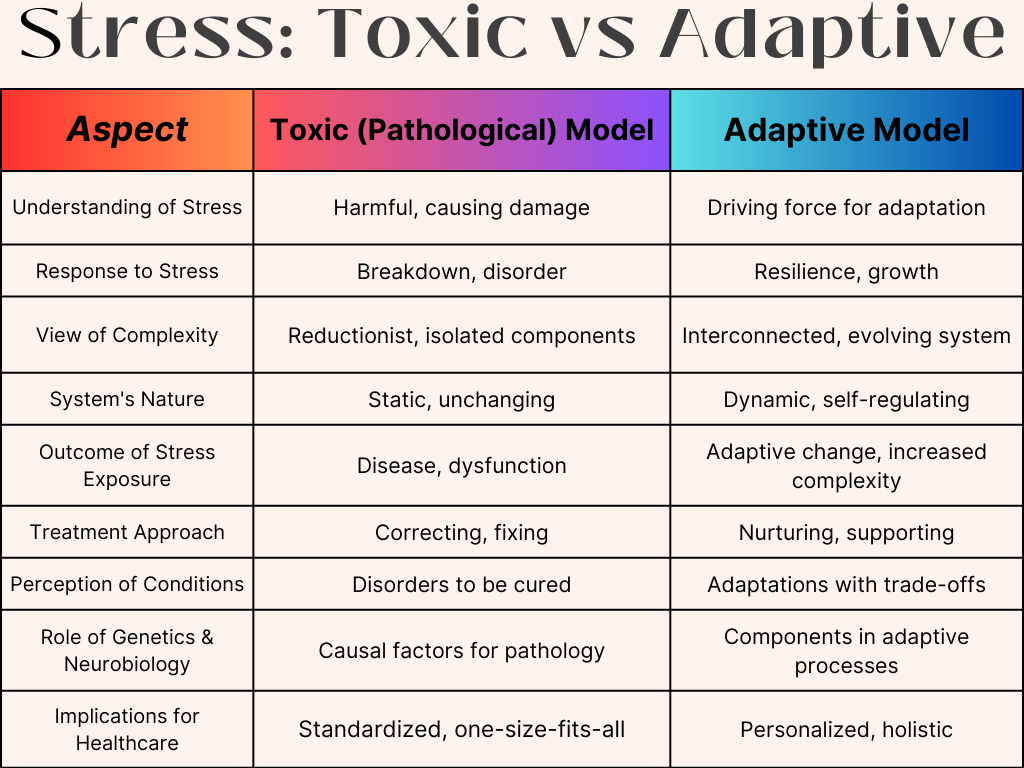
This chart provides a visual summary of the key differences between these two approaches to understanding stress.
| Aspect | Toxic (Pathological) Model | Adaptive Model |
|---|---|---|
| Understanding of Stress | Harmful, causing damage | Driving force for adaptation |
| Response to Stress | Breakdown, disorder | Resilience, growth |
| View of Complexity | Reductionist, isolated components | Interconnected, evolving system |
| System’s Nature | Static, unchanging | Dynamic, self-regulating |
| Outcome of Stress Exposure | Disease, dysfunction | Adaptive change, increased complexity |
| Treatment Approach | Correcting, fixing | Nurturing, supporting |
| Perception of Conditions | Disorders to be cured | Adaptations with trade-offs |
| Role of Genetics & Neurobiology | Causal factors for pathology | Components in adaptive processes |
| Implications for Healthcare | Standardized, one-size-fits-all | Personalized, holistic |
This chart highlights the profound differences between the toxic (pathological) model and the adaptive model. While the former perceives stress as a negative influence leading to breakdown and disease, the latter understands stress as an essential component in a dynamic, resilient system that drives growth and adaptation. The implications of this shift are far-reaching, affecting everything from our fundamental understanding of human conditions like autism to the very approach to healthcare, moving from a fixing mentality to one of support and nurturing. It offers a roadmap to a more compassionate, equitable healthcare system aligned with the principles of complex adaptive systems.


Leave a Reply