
The New York Times just published a piece called “Short Naps, Long Hours: How Autism Clinics Squeeze Medicaid Dollars Out of Preschoolers” (Ghorayshi, May 23, 2026). It follows months of Wall Street Journal investigations exposing what many autistic adults and their families have known for years: the Applied Behavior Analysis (ABA) industry has become a multi-billion-dollar Medicaid operation with staggering rates of fraud, overbilling, and — at the human level — children subjected to 30- to 40-hour therapy weeks designed around compliance, with documentation showing some children receiving over seven hours of behavioral therapy a day, five days a week, for years (WSJ, March 2026; HHS-OIG audits of Indiana, Colorado, and Wisconsin, 2024–2026).
The financial corruption is a scandal. But the deeper problem is structural, and it precedes the fraud: the behavioral model that ABA is built on was designed for a regulatory landscape that most neurodivergent people do not inhabit.
The Calorie Model
Here’s an analogy. In nutrition science, the calorie model says: calories in, calories out. If you eat more than you burn, you gain weight. If you eat less, you lose it. It’s linear. It’s intuitive. And for a significant portion of the population, it works reasonably well — not because metabolism is actually that simple, but because for many people, the other variables (hormonal regulation, gut microbiome, inflammatory tone, insulin sensitivity, sleep quality, stress load) are stable enough that they can be treated as roughly constant. When the background is held steady, the foreground variable — caloric balance — does most of the explanatory work.
But for people with metabolic conditions, autoimmune disorders, PCOS, thyroid dysfunction, chronic inflammation, or significant stress-driven metabolic disruption, the calorie model fails. Not because calories don’t matter, but because the variables it holds constant aren’t constant. The background has become the foreground. The system is spending its energy on regulation itself, and the simple input-output equation no longer captures what’s happening.
The same logic applies to behavioral models of autism intervention.
Flatland

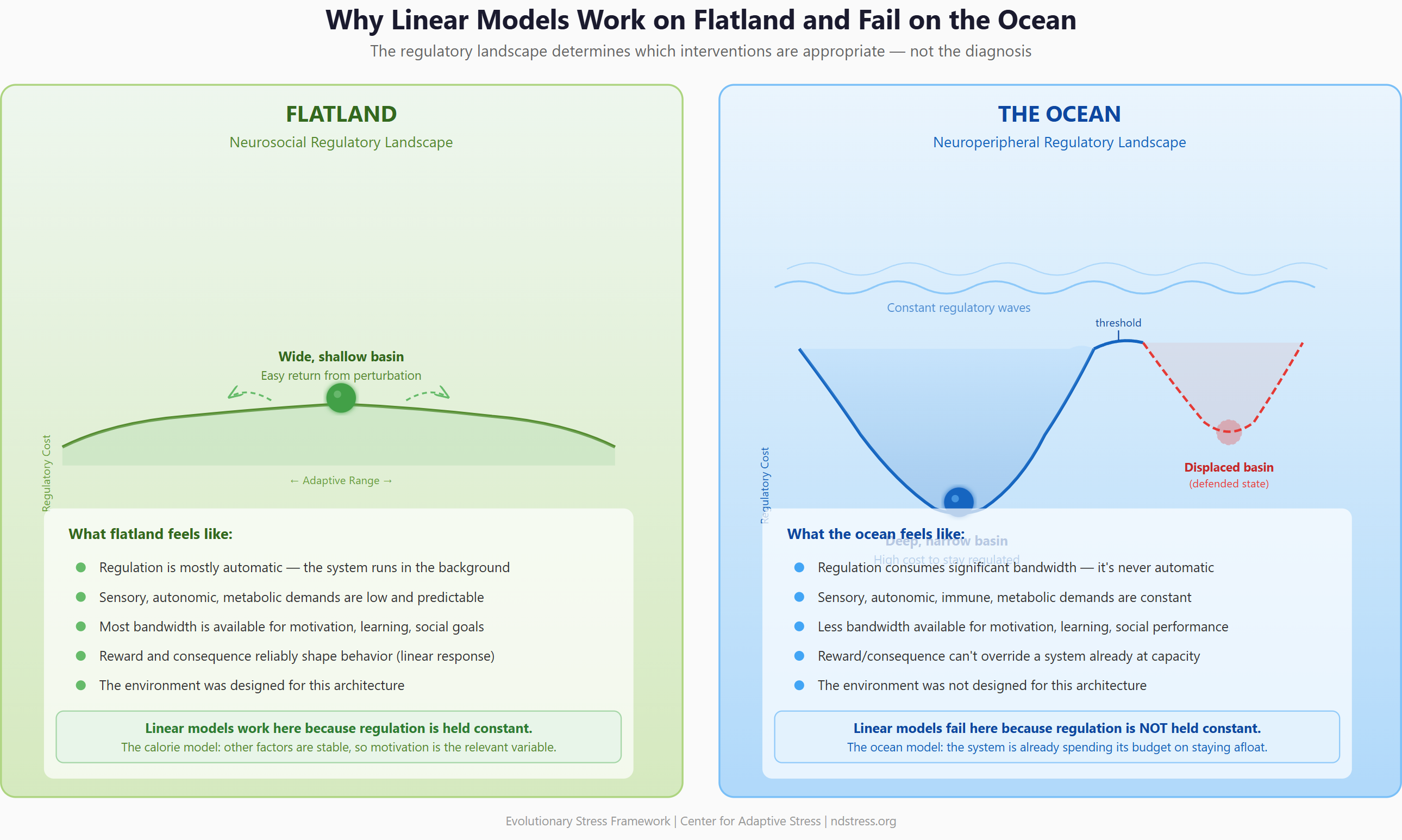
I think of the neurotypical — or “neurosocial” — regulatory landscape as flatland.
Flatland is not a criticism. It’s a description of a regulatory architecture where the terrain is relatively even, the basins are wide and shallow, and the system doesn’t have to spend much energy staying regulated. Sensory processing is calibrated to the built environment. Autonomic regulation runs mostly in the background. The immune system isn’t chronically activated. Sleep architecture does what it’s supposed to. Social prediction errors are manageable because the social world was designed around this architecture’s expectations.
On flatland, regulation is approximately held constant — like the metabolic variables in the calorie model. The system runs in the background, and most of the available bandwidth is free for other things: motivation, learning, social goals, behavioral flexibility, skill acquisition.
On flatland, linear models work. Reward and consequence reliably shape behavior because the system has the bandwidth to respond to them. Motivation is a meaningful variable because the organism isn’t spending its budget on staying upright. Practice leads to skill acquisition because the predictive processing system has the energy to update its models. The relationship between effort and outcome is approximately proportional.
This is the landscape that ABA was designed for.
B.F. Skinner’s operant conditioning — the theoretical foundation of ABA — was developed studying animals in controlled environments where every other variable was held constant: temperature, lighting, feeding schedule, cage design, social conditions. The only thing that varied was the contingency structure: which behaviors were reinforced and which were not. Under those conditions, behavior is remarkably lawful and linear. Press the lever, get the pellet. The organism learns.
The problem is not that operant conditioning is wrong. It’s that it assumes flatland.
The Ocean
The neurodivergent — or “neuroperipheral” — regulatory landscape is not flatland. It’s the ocean.
On the ocean, the system is never still. Sensory processing is running at different gain settings than the environment was designed for — too much signal, too little filtering, or unpredictable alternation between hyper- and hypo-responsivity. The autonomic nervous system is managing threat detection in a world that generates constant low-level prediction errors because it was built for a different architecture. The immune system may be chronically activated. Sleep may not restore the way it should. Metabolic resources are being consumed by regulatory processes that neurotypical systems handle cheaply or automatically.
On the ocean, regulation is not held constant. It’s the primary expense. The system is spending its bandwidth on staying afloat — managing sensory load, maintaining autonomic coherence, processing social prediction errors that arrive faster than the system can update, suppressing authentic responses to produce socially expected ones (masking), and managing the physiological cost of all of this.
When you’re on the ocean, the variables that flatland models treat as background — sensory regulation, autonomic state, immune-metabolic load, sleep integrity, interoceptive coherence — are consuming the budget. There is less bandwidth available for the things linear models target: motivation, compliance, skill performance, social reciprocity, behavioral flexibility.
This is why reward and consequence don’t work the same way on the ocean. It’s not that the child doesn’t understand the contingency. It’s not that they lack motivation. It’s that the system is already at capacity. Adding a reward doesn’t free up bandwidth. Adding a punishment doesn’t create regulatory resources. The lever-and-pellet logic assumes a system with spare capacity to redirect. On the ocean, that spare capacity has already been spent on staying regulated in a world that wasn’t designed for this body.
What Happens When You Apply Flatland Models on the Ocean
When ABA is applied to a child whose regulatory architecture is on the ocean — running high sensory load, managing autonomic threat responses, metabolically expensive just to be present in a fluorescent-lit room full of unpredictable social demands — the model doesn’t just fail to help. It can actively drive the system deeper.
Thirty to forty hours a week of contingency-based behavioral therapy is thirty to forty hours of additional demand on a system that is already spending its budget on regulation. The child is being asked to produce compliant behavior — eye contact, sitting still, responding on cue, suppressing stims, tolerating sensory environments — while simultaneously managing the regulatory costs that make those behaviors expensive in the first place.
The therapy treats the behavioral surface. It does not see the regulatory ocean underneath.
From a dynamical systems perspective, this creates exactly the conditions for basin displacement. The system is pushed past its capacity for coherent regulation — not by a single acute event, but by sustained, daily, hours-long demand that strikes the architecture’s fragile dimensions. The child’s regulatory system may reorganize into a defended configuration: withdrawal, shutdown, loss of previously acquired skills, increased distress behaviors, autonomic dysregulation. And then medicine names this deterioration a “regression” or a “worsening of symptoms” — as if the child has gotten more autistic, when what has happened is that their regulatory system has been pushed past threshold by the very intervention that was supposed to help (Kupferstein, 2018; McGill & Robinson, 2020).
The fraud and the harm are connected. An industry built on a model that doesn’t understand the terrain it’s operating on will inevitably produce both: financial exploitation because the model can always justify more hours (the child hasn’t “improved enough” — add more therapy), and human harm because the intervention is adding load to a system already at capacity.
The Basin Geometry Makes This Visible
The ESF makes this distinction formal through attractor basin geometry.
A neurosocial architecture typically operates in a wide, shallow basin. The system has a broad adaptive range. Perturbations — a bad night’s sleep, a stressful social interaction, a change in routine — push the system away from its resting state, but not far. The walls of the basin are gentle. Recovery is quick. The system returns to its operating point without much effort.
In this landscape, behavioral interventions work the way they’re supposed to. The system has headroom. You can add demand (practice, social challenge, new learning) without destabilizing the regulatory foundation. The contingency structure — reward, consequence, motivation — is operating in the space above the regulatory floor, where bandwidth is available.
A neuroperipheral architecture may operate in a narrower, deeper basin. The system is viable — it’s not “broken” — but the basin walls are steeper, the regulatory costs are higher, and the distance to the basin boundary is shorter. Less perturbation is needed to push the system toward threshold. Recovery takes longer. The bandwidth available above the regulatory floor — the bandwidth that would be used for learning, motivation, social flexibility — is smaller, because more of the system’s resources are being consumed by the regulatory work of staying in the basin at all.
And critically, there may be a second basin nearby — a defended, withdrawn, energy-conserving configuration that the system can be pushed into if demand exceeds capacity for long enough. Once displaced, the system stabilizes in the new basin, and the conditions required to return may be quite different from the conditions that caused the displacement. This is hysteresis: the path out is not the reverse of the path in.
What Would Work Instead
If the ocean is the problem space, then the intervention logic changes entirely.
The first question is not “how do we change this behavior?” The first question is “what is the regulatory cost of being in this environment right now?” What is the sensory load? What is the autonomic state? What is the prediction-error burden? How much bandwidth is being consumed by masking, by social performance, by managing an environment designed for a different architecture?
The second question is “how do we widen the basin?” — not through more demand, but through reducing the regulatory load that narrows it. Sensory accommodation. Predictability. Co-regulation. Adequate sleep and metabolic support. Environmental redesign. Communication access that doesn’t require the most expensive processing the system does. Rest that is actually restorative, not just absence of therapy.
The third question is “is this child depleted or displaced?” If depleted — bandwidth narrowed but still in the home basin — reducing demand and supporting recovery may be sufficient. If displaced — the system has crossed into a defended configuration — the intervention needs to address the entire regulatory landscape simultaneously, not just one behavioral surface.
None of this means doing nothing. It means doing the right thing for the terrain. Regulation-based approaches — supporting the body’s capacity to manage its own regulatory demands — are not less rigorous than behavioral approaches. They’re more rigorous, because they require understanding the architecture rather than just measuring the behavior.
The Linear Model Is Not Wrong. It’s Incomplete.
On flatland, where regulation is cheap and bandwidth is available, linear behavioral models capture something real. Motivation matters. Contingencies shape behavior. Practice builds skill. Reward works.
On the ocean, where regulation is expensive and bandwidth is consumed, the same models miss the load-bearing variable. They see the behavior and miss the regulation underneath it. They add demand to a system already at capacity and call it therapy. They measure compliance and miss the regulatory cost of producing it. They see a child who “isn’t responding to treatment” and prescribe more hours, when the hours themselves are part of the problem.
The shift is not from behavioral models to no models. It’s from models that assume flatland to models that can see the ocean. From models that hold regulation constant to models that put regulation at the center. From models that treat the surface to models that understand the depth.
The neurodiversity movement has been saying this in ethical and experiential terms for years. The Evolutionary Stress Framework says it in mechanistic terms: the terrain determines which tools are appropriate. And when you bring flatland tools to the ocean, you don’t just fail to help. You can cause the very harm you set out to prevent.
This post reflects the perspective of the Evolutionary Stress Framework (ESF), a complexity science approach to stress physiology and neurodevelopmental variation developed by the Center for Adaptive Stress. The ESF is a conceptual lens for organizing problems and interpreting variation; it does not constitute medical advice or clinical diagnosis.
The author uses “neurosocial” and “neuroperipheral” as ESF-specific terms: neurosocial referring to regulatory architectures whose processing priorities align with the social-communicative demands of the majority-designed environment, and neuroperipheral referring to architectures whose processing priorities diverge from those assumptions, incurring additional regulatory costs in standard contexts.
References
Dawson, M., & Fletcher-Watson, S. (2022). When autism researchers disregard harms: A commentary. Autism, 26(2), 564–566.
Ghorayshi, A. (2026, May 23). Short naps, long hours: How autism clinics squeeze Medicaid dollars out of preschoolers. The New York Times. https://www.nytimes.com/2026/05/23/health/autism-therapy-clinics.html
Del Giudice, M., Buck, C. L., Chaby, L. E., et al. (2018). What is stress? A systems perspective. Integrative and Comparative Biology, 58(6), 1019–1032.
Hogenkamp, L., Sanghavi, D., & Natri, H. (2026). Toward an emergent paradigm for neurodiversity and health. Autism in Adulthood. DOI: 10.1177/25739581261433443.
Hull, L., Petrides, K. V., Allison, C., et al. (2017). “Putting on my best normal”: Social camouflaging in adults with autism spectrum conditions. Journal of Autism and Developmental Disorders, 47, 2519–2534.
Kupferstein, H. (2018). Evidence of increased PTSD symptoms in autistics exposed to applied behavior analysis. Advances in Autism, 4(1), 19–29.
McGill, O., & Robinson, A. (2020). “Recalling hidden harms”: Autistic experiences of childhood applied behavioural analysis (ABA). Advances in Autism, 7(4), 269–282.
Raymaker, D. M., Teo, A. R., Steckler, N. A., et al. (2020). “Having all of your internal resources exhausted beyond measure and being left with no clean-up crew”: Defining autistic burnout. Autism in Adulthood, 2(2), 132–143.
Sandoval-Norton, A. H., & Shkedy, G. (2019). How much compliance is too much compliance: Is long-term ABA therapy abuse? Cogent Psychology, 6(1), 1641258.
Scheffer, M., Bockting, C. L., Borsboom, D., et al. (2024). A dynamical systems view of psychiatric disorders — Theory: A review. JAMA Psychiatry, 81(6), 618–623.
Shkedy, G., Shkedy, D., & Sandoval-Norton, A. H. (2021). Long-term ABA therapy is abusive: A response to Gorycki, Ruppel, and Zane. Advances in Neurodevelopmental Disorders, 5, 126–134.

Leave a Reply