
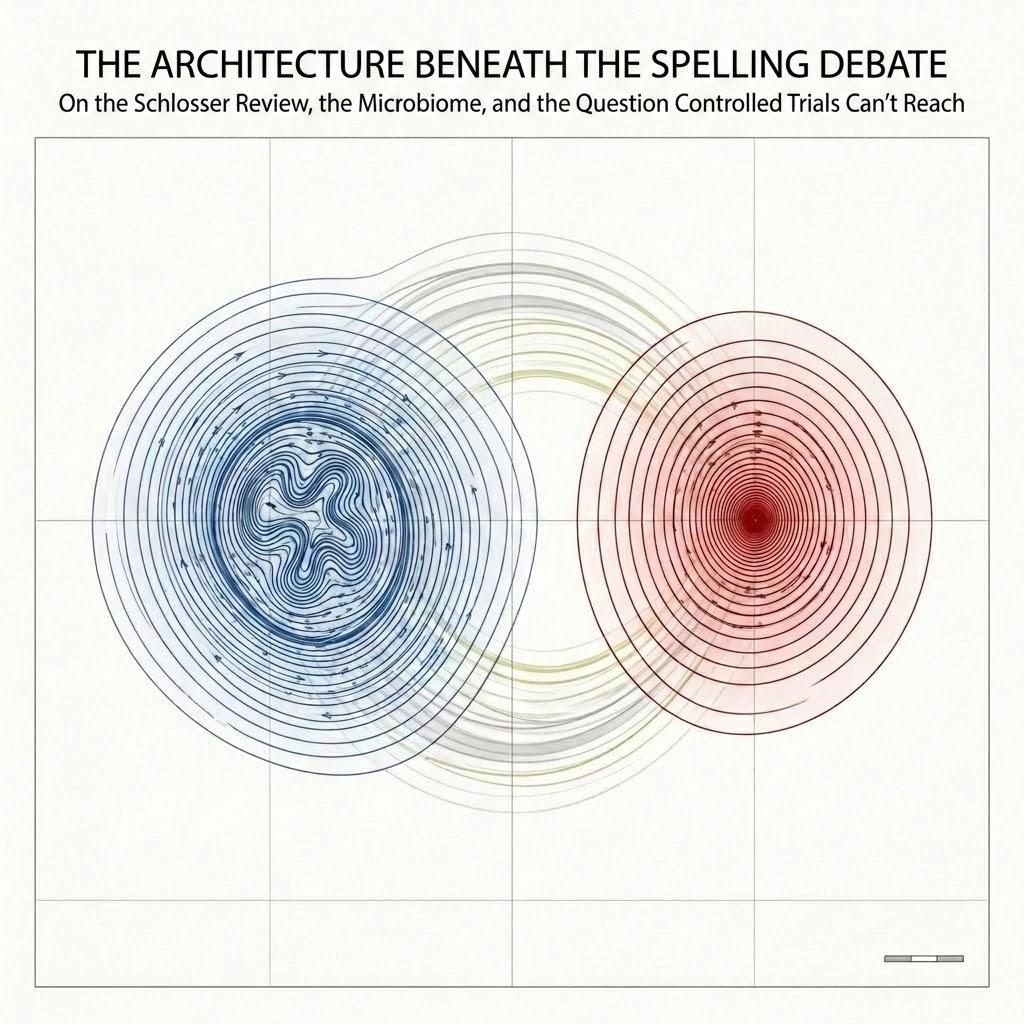
On the Schlosser Review, the Microbiome, and the Question Controlled Trials Can’t Reach
Note: Nothing in this argument reduces the importance of protecting nonspeaking individuals from facilitator influence, coercion, projection, or misattributed communication.
The Architecture Beneath the Spelling Debate
On the Schlosser Review, the Microbiome, and the Question Controlled Trials Can’t Reach
The neuroscientist Kevin Mitchell has argued, across various writings on the gut-brain axis, that within the evidentiary standards of mechanistic causal biology — replicable effect sizes, specified causal pathways, controlled manipulation of single variables — the evidence for most microbiome-behavior claims is weak to nonexistent. He is not wrong. The standard he applies is the standard the field uses when it wants to know whether a specific intervention produces a specific outcome through a specific mechanism. By that standard, the answer is usually “we don’t actually know yet.”
What Mitchell’s standard cannot see — because it is not built to see it — is the kind of phenomenon that microbiome-host coupling actually is. The gut and the nervous system are not a simple cause-and-effect pair. They are two complex adaptive systems in continuous reciprocal coupling across multiple timescales, with thousands of interacting agents on each side, where the relevant signal lives in distributed, context-dependent, multi-causal patterns that single-variable trial designs are specifically designed to filter out as noise. Mitchell’s methodology is sound. Mitchell’s methodology is also unable to see the phenomenon that complexity-science approaches to microbiome biology have been trying to characterize for the better part of two decades.
Both things are true at once. The methodological critique is sound. The existence of reciprocal gut-brain coupling as a complex adaptive phenomenon is real, even where specific mechanistic claims about particular microbiome-behavior pathways remain weak or unsettled. The field needs both kinds of science — the careful single-variable work that protects us from premature claims of mechanism, and the systems-level work that can ask what coupling does over time in heterogeneous populations. Neither replaces the other. Neither is wrong. They are asking different questions.
This is the epistemological structure of what is happening this month in the autism field.
What Schlosser et al. Established
On May 4, 2026, the Review Journal of Autism and Developmental Disorders accepted a systematic review by Ralf Schlosser, Howard Shane, Lucy Bryant, Katharine Beals, James Todd, Russell Lang, Sharon Skinner, and Bronwyn Hemsley: Systematic Review of Authorship in Rapid Prompting Method, Spelling to Communicate, and Variants: Outcomes, Significance and Clinical Implications. The review was PROSPERO-registered, PRISMA-compliant, and methodologically immaculate. It searched twelve databases, screened more than seven thousand records, and asked one specific question: has any controlled study, using a priori manipulation of facilitator knowledge, demonstrated independent authorship of messages produced through Rapid Prompting Method, Spelling to Communicate, or their variants?
The answer was zero. Not one study met the inclusion criteria. The review is empty.
This is the second PROSPERO-registered systematic review nine years apart to return that result. The first was Schlosser et al. (2019). Two successive registered reviews. Nine years of opportunity for proponents to produce controlled authorship trials. Zero controlled authorship trials produced.
Within the evidentiary frame the review applies — controlled message-passing tests where the facilitator and the facilitated person have access to different information, where authorship can be empirically established — the conclusion is sound. The methodology is exactly the methodology you would apply if your question is who is generating these specific messages right now, the person or the facilitator. That is a question worth asking. It is, in fact, the question that has to be asked of any method that claims to surface a person’s own previously inaccessible thoughts. The Schlosser review is not wrong to ask it, not wrong to apply the standard rigorously, and not wrong to conclude that the standard has not been met.
Amy Lutz cited this review in her May 2026 New York Times essay arguing that FC-descendant methods are being repackaged without the evidence to support them. That citation is exactly what good-faith engagement with the empirical record looks like. She is not dismissing nonspeakers. She is asking the field to meet its own methodological standards before scaling a practice that, in its earlier facilitator-dependent form, has been shown across decades of controlled trials to produce messages controlled by the facilitator rather than the facilitated person. The question Lutz is asking is a real question.
What Prizant’s Response Reveals
Barry Prizant’s response to Lutz cited credentials, fifty years of clinical experience, and a 2026 peer-reviewed paper in Autism Research by Jaswal, Prizant, Barense, Patten, and Stobbe — Why we need to study assisted methods to teach typing to nonspeaking autistic people. This was the paper offered as the strongest contemporary scientific support for the position that these methods warrant continued research and use.
The Schlosser review classifies Jaswal et al. (2026) as commentary. It appears in the Table 1 note among full-text articles excluded for providing “commentary on RPM/S2C or its variants,” alongside Bigby (2025), Griffiths et al. (2025), Hemsley et al. (2025), Sari et al. (2026), and Weiler & Woollacott (2025). By the methodological standard the review applies, the Jaswal et al. paper does not constitute evidence of authorship. It is an argument that authorship-testing research should be done — not authorship-testing research itself.
That classification is not a sleight of hand. By the Schlosser review’s criteria, which require a priori controlled manipulation of facilitator knowledge to empirically establish who is authoring the messages, a paper arguing for the importance of such research does not count as such research. The methodological frame is consistent. Within that frame, Prizant’s strongest cited source is not evidence at the level the review is asking about.
This is uncomfortable. It is also methodologically correct. And it means that, on the specific axis the Schlosser review is asking about — is there controlled evidence of independent authorship — the answer remains zero, including from the paper Prizant cited last week.
The Question the Frame Cannot Reach
Here is where the Mitchell parallel matters.
The Schlosser review’s methodology is sound. It is also optimized for adjudicating authorship at a given moment in a given dyad — not for characterizing the developmental coupling dynamics that an architectural account of nonspeaking autism would have to characterize.
Two nervous systems in prolonged, intensive, close physical and attentional coupling do not exhibit only “person authoring” or “facilitator authoring.” Dyadic neuroscience documents attentional synchrony, predictive entrainment, affective co-regulation, and interpersonal motor coupling as robust, measurable phenomena that emerge under sustained reciprocal contact between two nervous systems. These are not mystical or telepathic claims; they are well-characterized features of how nervous systems behave when placed in close interactive coupling over time. Under prolonged dyadic conditions, the pair can exhibit partially shared dynamical states — without implying identical agency, identical consciousness, or that messages produced during such coupling reflect the cognitive content of one partner rather than the other.
From an Evolutionary Stress Framework perspective — a complexity-science conceptual lens I have been developing for stress physiology and neurodevelopmental variation — the population of minimally- and non-speaking autistic individuals is not architecturally homogeneous. This framework suggests that some nervous systems in this population have severe motor-planning constraints with relatively intact receptive language. Some have severe receptive language constraints. Some have profound regulatory dysregulation that compromises both. Some have combinations that shift across development. Across this heterogeneity, a dyadic scaffolding practice is not one intervention being applied to one population. It is one form of dyadic coupling being applied across architecturally different nervous systems at architecturally different developmental moments — and the same procedure could be doing different things in different pairs.
In some dyads, the scaffolding may be doing exactly what the Schlosser review documents: the facilitator is, unwittingly or otherwise, generating the messages. In some dyads, it may be doing something developmental — providing co-regulatory support that, over time, scaffolds the emergence of independent motor sequencing, much as parental co-regulation scaffolds the emergence of independent self-regulation in typical development. In some dyads, it may be doing both at once, in shifting proportions over time.
It is essential to keep two questions separate here. Even if some forms of dyadic scaffolding prove developmentally useful for certain nervous-system architectures over time, that would still not establish independent authorship of any specific message produced during the scaffolded phase. Developmental utility and authorship validity are distinct empirical questions, requiring distinct methodologies, and they can yield distinct answers about the same dyad.
The developmental research question — and this is the one neither side of the public debate is asking — is this:
Under what conditions does scaffolded coupling build independent capacity, and under what conditions does it substitute for it?
That is an architectural, developmental, longitudinal question. It is not the question Schlosser et al. are asking, and it is not a question their methodology is built to answer. Their methodology is built to answer: at this moment, in this trial, in this dyad, who is authoring these messages. Both questions matter. They are different questions.
What the Independent Typists Mean — and Don’t Mean
Prizant cites individuals — Elizabeth Bonker, Hari Srinivasan, Jordyn Zimmerman — who began with facilitator-dependent methods and now type independently. These are real people. Their independent typing, where it has been established under conditions that meet authorship criteria, is real.
What that fact does not establish, by itself, is whether the early facilitator-dependent phase caused, accompanied, or was incidental to the eventual emergence of independent typing. The trajectory from dependent to independent could reflect: scaffolded developmental progression; spontaneous developmental progression that would have occurred without the facilitator; selection effects in which the dyads that produced independent typists were the ones in which the architectural conditions for independent typing were already present; or some mixture of all three. We do not know, because the studies that could distinguish these have not been done.
This is the same epistemological situation as the microbiome case. The phenomenon — eventual independent typing in some individuals — is real. The mechanistic question — what role, if any, did the dyadic scaffolding play in producing it — is empirically unsettled. That unsettled-ness is not a refutation of either position. It is the actual state of the evidence, and it is the question the field would have to study, longitudinally and developmentally, to know.
What This Framework Can and Cannot Say
The Evolutionary Stress Framework is a conceptual lens for thinking about neurodevelopmental variation as architectural heterogeneity in biological control systems under stress. It is not medical advice. It does not validate or invalidate any specific communication method for any specific person. It does not claim that any specific dyad is producing authentic communication, and it does not claim that any specific dyad is not.
What this framework suggests is that the binary “the person is authoring / the facilitator is authoring” is unlikely to be the right level of description for what is happening in dyadic scaffolding practices, because the binary forecloses the architectural and developmental questions that would actually need to be asked to know what is happening in any given dyad over time. It suggests that the population is architecturally heterogeneous in ways the binary cannot register. And it suggests that the field needs a different kind of science — longitudinal, developmental, complexity-aware, architecturally honest about heterogeneity — layered alongside the controlled-trial work, not as a replacement for it.
Schlosser et al. (2026) have done the controlled-trial work, and they have done it well. The field needs the other work too. Neither replaces the other.
Where This Leaves the Conversation
To the families who have entered these practices in good faith and observed real improvements in their children’s communication: the improvements you have observed are not nothing, and the question of what produced them is a serious developmental-scientific question that has not been adequately studied.
To the practitioners who are convinced that the methods are working: the question of whether what is working is authentic communication versus facilitator-generated content, in any specific dyad you are working with, is exactly the question the Schlosser review identifies as unresolved. Independent authorship testing, before assuming that the messages reflect the person’s own intentions, is not an attack on the practice. It is the minimum responsible step, and one the review explicitly recommends for any individual already using these techniques.
To the families and advocates who have looked at the methods and seen what Lutz sees: your concern about the autonomy and communication rights of vulnerable nonspeakers is grounded in decades of controlled research and is not refuted by the existence of individuals who eventually type independently. The communication-rights argument is real, and the Schlosser review is right to foreground it.
And to the field: the developmental question — under what conditions does scaffolded coupling build independent capacity, and under what conditions does it substitute for it — is the research program the empty reviews are pointing toward. Not because the controlled trials should stop. Because they are necessary and insufficient. The architectural science is what would tell us what kind of intervention this is, for which kinds of nervous systems, at which developmental moments, with what kinds of long-term effects. That work has not been done. It is the work that needs to be done.
Nothing in this argument reduces the importance of protecting nonspeaking individuals from facilitator influence, coercion, projection, or misattributed communication. The communication-rights concerns Schlosser et al. foreground are foundational. An architectural-developmental research program would have to be built on top of those protections, not in spite of them — and the controlled-trial standard the review represents is what makes those protections enforceable in practice.
Mitchell is right about the microbiome literature, within his frame. Schlosser et al. are right about the authorship literature, within theirs. Both are correct. Both leave the architectural questions open. The architectural questions are the ones the field has not yet learned how to ask.
That is the conversation worth having.
The Evolutionary Stress Framework (ESF) is a complexity-science conceptual lens for stress physiology and neurodevelopmental variation. It is not a clinical method, a diagnostic tool, or medical advice. This essay does not endorse or oppose any specific communication practice; it argues for the importance of developmental-architectural science alongside the controlled-trial standard, and for the methodological soundness of both the controlled-trial work the Schlosser review represents and the complexity-science work that would be needed to answer the developmental questions that work cannot reach.

Leave a Reply