
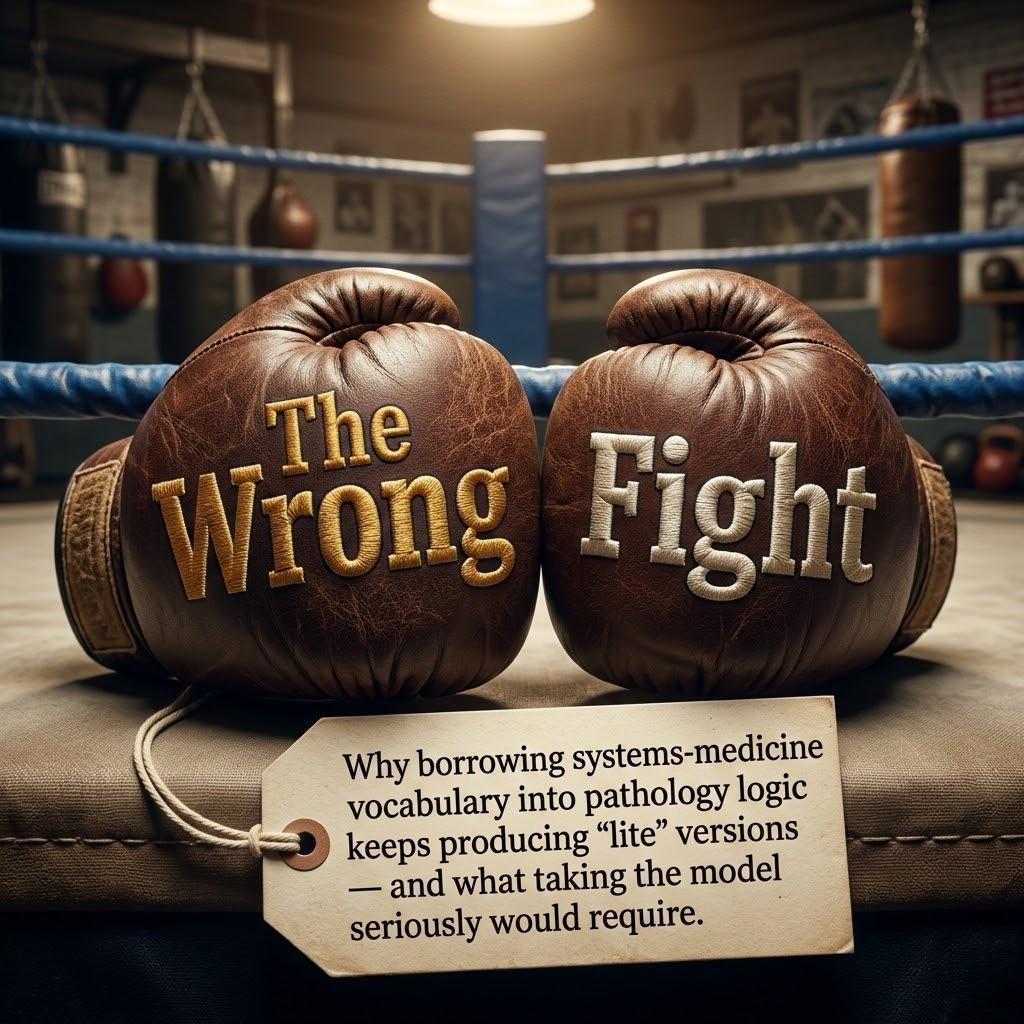
Why borrowing systems-medicine vocabulary into pathology logic keeps producing “lite” versions — and what taking the model seriously would require.
It’s not the word. It’s the model the word is doing work inside.
We’ve been having the wrong fight for decades.
Every few years, a new vocabulary arrives — regulation, resilience, allostasis, optimization, neurodiversity, systems — and within a decade or two it gets absorbed, softened, and turned into a wellness slogan, a productivity frame, or an institutional branding exercise. Then the community that built the word has to defend it, gatekeep it, or abandon it. Another vocabulary arrives. The same cycle starts over.
The pattern isn’t language drift. It’s model drift. The words keep arriving because the underlying conceptual shift is real and ongoing. The words keep getting absorbed because the dominant clinical model can’t actually hold them. So they get translated into something it can hold — and what survives the translation is the shell of the word, not its meaning.
To get out of the cycle, we have to stop fighting over vocabulary and start naming what’s happening underneath.
Two Models
Medicine right now is operating across two conceptual models at once.
The first is the single-source pathology model, consolidated over roughly the last 150 years. It was built for discrete disruptors: pathogens, lesions, fractures, mutations. It works beautifully where it fits. Antibiotics. Vaccines. Surgical repair. Acute trauma. Many monogenic conditions. Real wins, real lives saved, and it remains the right tool for an enormous slice of clinical work. (More precisely, it is a dominant lesion-based, discrete-disruptor model — pathology medicine has always had multifactorial strands; what’s consolidated is the discrete-disruptor logic as the default frame.)
The second is the regulatory systems model, which attempts to integrate phenomena the first model struggles to adequately explain. Chronic illness. Autoimmune disease. Neurodevelopmental variation. Autonomic conditions. Mental health. The brain-body clusters that increasingly cluster together — EDS, POTS, MCAS, ME/CFS, long COVID — along with the complex co-occurrence patterns that fragment under single-specialty workup. These aren’t discrete-disruptor phenomena. They’re regulatory architectures interacting with environments, loads, developmental histories, and recovery states — dynamic by nature, distributed across systems, and resistant to lesion-based diagnostic logic.
The second model is still being built. Allostatic load, predictive processing, complexity-science approaches to physiology, brain-body integration research, the architectural account of neurodevelopmental variation — these are pieces of a conceptual scaffolding that hasn’t fully consolidated. It’s developmental and integrative, not a finished replacement for what came before.
Both are medicine. Neither replaces the other. Single-source phenomena need single-source thinking. Regulatory phenomena need systems thinking. The problem isn’t that pathology medicine exists. It’s that we’ve been asking one model to do both jobs — and when it can’t, we’ve borrowed the other model’s vocabulary to soften the failure.
How “Lite” Happens
Before going further, a note on lineage. The term “neurodiversity-lite” was coined by Shain M. Neumeier (2018) in their Rewire News piece “‘To Siri With Love’ and the Problem With Neurodiversity Lite,” and has been developed substantially since by Robert Chapman, Nick Walker, Jenna Roberts and the Therapist Neurodiversity Collective, Helen Edgar, and others. The disability-justice and autistic-led critique they have built names what neurodiversity-lite does — the marketization, the performative inclusion, the institutional appropriation. What I am trying to add is a layer underneath: why the pattern keeps recurring, located in the architecture of the model doing the absorbing. I take up the lineage question more fully in a separate positioning piece, On Lineage: Where “Neurodiversity-Lite” Comes From, and What I’m Adding.
Here’s the move I want to name.
Borrowing vocabulary from the second model while still running the first one is what produces every flavor of “lite.”
The word arrives carrying the conceptual content of the systems model. The receiving environment is still running pathology logic. So the word gets translated into what pathology logic can hold — and the translation strips out exactly the architectural meaning the word was built to carry. Four examples make the pattern visible.
Resilience inside pathology logic becomes grit.
In the systems model, resilience is a property of the system in context. It depends on supports, reserves, environmental fit, recovery state, and what the architecture is being asked to carry. It can be exhausted. It includes both robustness (resistance to change) and flexibility (ability to reconfigure). Pull it inside pathology logic and it collapses into an individual character trait. What doesn’t kill you makes you stronger. Used to blame people who can’t bounce back — not resilient enough. Disconnected from supports, reserves, and recovery state. The word survives. The architectural content doesn’t.
Optimization inside pathology logic becomes biohacking.
In the systems model, optimizing a regulatory architecture means recognizing what supports its bandwidth — recovery time, sensory environment, social load, predictable conditions. It’s about fit between architecture and context. Pull it inside pathology logic and it becomes a productivity frame: maximize output, push through, supplement the deficiency, hack the protocol. The architecture-environment relationship disappears. What remains is a self-improvement vocabulary that treats the body as something to be engineered toward higher performance.
Regulation inside pathology logic becomes self-help with a clinical accent.
In the systems model, regulation names a multi-scalar dynamic — cellular, autonomic, behavioral, social — by which a system maintains functional coherence across changing conditions. Both stabilizing and destabilizing dynamics are part of regulation; the system continuously modulates. The work of regulating costs energy and accumulates as load when conditions don’t fit. Pull it inside pathology logic and self-regulation becomes a behavioral skill to teach. Dysregulation becomes personal failure rather than a system’s response to mismatch. The word becomes a target for intervention — make the person more regulated — instead of a phenomenon to understand and support.
Neurodiversity inside pathology logic becomes the affirming poster in the lobby with nothing changed underneath.
In the systems model, neurodiversity describes architectural variation — distinct regulatory configurations across human nervous systems, none of them deviations from a baseline. Pull it inside the pathology logic, and it becomes a vocabulary refresh for the same categorical structure underneath. Affirming language, strengths-based framing, identity celebration — with no change to assessment, accommodation, environmental design, or who holds decision-making power. The same baseline-and-deviation model running underneath, just described more gently.
In each case, the word isn’t the problem. The model trying to hold it is. Pathology logic doesn’t adequately model multi-scalar dynamics, system-in-context resilience, architecture-environment fit, or distributed regulatory configurations. So when it absorbs these words, it compresses them into the deviation language its own framework can hold — and what’s left is the lite version.
The vocabulary survives. The meaning doesn’t.
Terminological Inclusion vs Architectural Inclusion
There’s a distinction worth naming here, because it explains why affirming language alone keeps failing.
Terminological inclusion is what happens when a system updates its vocabulary to signal that it values, welcomes, or accommodates a previously excluded group. Person-first language. Strengths-based framing. Diversity statements. Neurodiversity-affirming branding. These moves are real and not nothing — they signal intent, they shift the surface of institutional culture, and they raise the cost of overt hostility. They are the linguistic surface of inclusion.
Architectural inclusion is what happens when a system updates its underlying model so that previously excluded people are actually structurally accommodated. Different assessment tools. Different sensory environments. Different communication norms. Different time scales. Different criteria for what counts as evidence. Different decision-making structures. These are changes to the architecture of the institution, not to its vocabulary.
The two are not the same, and one does not produce the other. An institution can update its terminology without touching its architecture — and most do. This is exactly what neurodiversity-lite, resilience-as-grit, and regulation-as-self-help all are at the institutional scale: terminological inclusion sitting on top of unchanged architectures.
Terminological inclusion without architectural inclusion is what allows institutions to feel like they’ve done the work without actually doing it. It’s also what produces the conditional affirmation pattern, where the language stays warm until support needs become visible or expensive — at which point the framing snaps back to pathology, because pathology was the architecture running underneath all along.
You can’t language your way out of an architecture. The vocabulary can update without the model updating, and when it does, the people the vocabulary was supposedly built to include keep running into the unchanged structure underneath.
What the Second Model Does Differently
The second model isn’t a softer version of pathology. It’s a different architecture for thinking about clinical phenomena. A few of the moves that distinguish it.
It treats the system as the unit of analysis, not the disorder. The question is what the regulatory architecture is doing, how it’s modulating, what supports it has, and where it’s running under mismatch — not which discrete entity needs to be removed.
It treats dynamic variation as data about regulation, not evidence of inconsistency. That capacity varies hour to hour, day to day, season to season tells you about the architecture-environment relationship; it doesn’t tell you the person is faking.
It treats cost as a real clinical phenomenon distributed across systems — masking exhaustion, post-exertional crash, autonomic flares, threshold drift, cumulative-load expression in connective tissue and inflammation. The cost shows up on the dynamic side, and it doesn’t show up in lesion-based workup.
It treats environment as part of the clinical picture, not just biology in isolation. Adjusting the environment is treatment, not accommodation as charity.
It treats the patient as an architecture, not a deviation. There is no single normative architecture against which all configurations are evaluated. There are configurations, and configurations are part of how the species maintains adaptive diversity.
The PSAs in the ESF public-facing series are worked examples of these moves at different scales.
→ Neurodiversity-Lite — what happens when neurodiverse gets adopted at the term level without the underlying paradigm shift, building on the existing critique developed by Neumeier, Chapman, Walker, the Therapist Neurodiversity Collective, Edgar, and others.
→ Words Worth Defending — the conceptual collapse of regulation, allostasis, metabolism, and resilience when pulled inside the wrong model.
→ Single-Source or Regulatory? — how to tell which kind of phenomenon you’re looking at, and which tool is built for it.
→ Where the Cost Lives — what regulatory cost looks like in a body, why standard workup misses it, and what taking it seriously clinically requires.
→ Stigma Keeps Shifting — why anti-stigma strategies keep producing new forms of stigma when the underlying model that generates stigma stays intact.
→ But There Are Already Lots of Models — the nonlinearity test for distinguishing a genuinely complexity-based clinical architecture from existing frameworks that use systems vocabulary while preserving linear assumptions underneath.
Each is pointing at the same phenomenon from a different scale. The lite pattern at the term level, the construct level, the clinical level, the embodied level, the historical level, and the methodological-epistemic level — all of them produced by the same underlying mismatch: vocabulary borrowed from a model that the receiving environment isn’t actually running.
The Wrong Fight
The fight we’ve been having for decades is the wrong fight.
It’s not whether to use neurodiverse or neurodivergent. It’s not whether resilience is empowering or ableist. It’s not whether self-regulation is therapeutic or moralistic. Those fights are real, and the people fighting them are right to fight — but the fights are downstream of something the language can’t reach.
We keep trying to defend new words inside old architectures. The words survive. The meaning doesn’t. The architecture keeps running.
The shift we need isn’t anti-pathology. It’s recognizing that medicine needs more than one model — that different classes of phenomena require different explanatory architectures, and that asking one tool to do both jobs is part of how we got here. Single-source disruption gets single-source thinking. Regulatory phenomena get systems thinking. Both are medicine. Neither replaces the other. But the second model has to actually be doing the work — not just lending its vocabulary to the first model to soften the failure.
The vocabulary isn’t the problem. The missing model is.
Lori Hogenkamp is Director of the Center for Adaptive Stress and developer of the Evolutionary Stress Framework. The PSAs referenced in this essay, along with the companion piece On Lineage: Where “Neurodiversity-Lite” Comes From, and What I’m Adding, are available at ndstress.org. Further development of the framework is at evostress.blog.
The ESF PSA Series
A public-facing companion to The Wrong Fight and On Lineage. Six short PDFs, each running the same diagnostic at a different scale: the model underneath, not the vocabulary on top.
The ESF PSA series exists because the long-form argument — that medicine is operating across two conceptual models at once, and that borrowing systems-medicine vocabulary into pathology logic keeps producing “lite” versions of every important construct — needs worked examples to land. Each PSA takes the same diagnostic question (is the model underneath actually doing the work the vocabulary is asking it to do?) and runs it at a different scale: at the level of a single term, a cluster of constructs, a clinical encounter, an embodied phenomenon, a historical arc, or a methodological standard.
The series is designed to be read in any order. Each PSA stands alone. Together, they’re meant to make the underlying pattern visible from enough angles that the architectural critique becomes hard to look away from.
The longer essays that frame the series are The Wrong Fight — which develops the two-model argument and introduces the terminological vs architectural inclusion distinction — and On Lineage, which positions this work inside the existing disability-justice and autistic-led critique of “neurodiversity-lite” and credits the scholars and advocates who built the term.
Suggested Reading Order
The PSAs are designed to be read in any order, but a few entry points work well depending on who you are:
→ If you’re new to the ESF critique: start with The Wrong Fight, then PSA 1 (Neurodiversity-Lite) and PSA 3 (Single-Source or Regulatory?).
→ If you’re a clinician or researcher: start with PSA 3 (Single-Source or Regulatory?) and PSA 4 (Where the Cost Lives), then PSA 6 (But There Are Already Lots of Models).
→ If you come from disability studies, critical disability scholarship, or autistic-led advocacy: start with On Lineage, then PSA 5 (Stigma Keeps Shifting) and PSA 1 (Neurodiversity-Lite).
→ If you’re working with words and want to defend them: start with PSA 2 (Words Worth Defending) and PSA 1 (Neurodiversity-Lite).
→ If you want the whole argument: The Wrong Fight → On Lineage → all six PSAs in order.
The Six PSAs
1. Neurodiversity-Lite: The Model Test, Not the Vocabulary Test
The opening piece. Ten flags for spotting when “neurodiversity-affirming” practice is using updated language inside an unchanged baseline-and-deviation model. Builds on the existing critique developed by Shain M. Neumeier (2018), Robert Chapman, Nick Walker, Jenna Roberts and the Therapist Neurodiversity Collective, Helen Edgar, and others. Extends that critique into a complexity-science register — asking why the pattern keeps recurring, located in the architecture of the model doing the absorbing.
2. Words Worth Defending
The vocabulary rescue. Four terms — regulation, allostasis, metabolism, resilience — that each name something real and irreducible in the systems model, and each get absorbed and stripped of meaning when pulled inside single-source pathology logic. For each term: a clinical anchor, what it actually means in a systems frame, and what it collapses into in the wrong one. Companion to PSA 1 at the construct level rather than the term level.
→ Download PDF
3. Single-Source or Regulatory? A Framework Question for Clinical Care
The clinical diagnostic. Three checklists for distinguishing single-source phenomena (where the pathology model fits) from regulatory phenomena (where it doesn’t), with a third section identifying signs the wrong tool is being used. Designed for clinicians and researchers asking which kind of phenomenon is in front of me, and is my tool built for it? Pairs with PSA 4 (the embodied side of the same question).
→ Download PDF
4. Where the Cost Lives
The phenomenology of regulatory cost. What it looks like in a body — masking exhaustion, post-exertional crash, autonomic flares, capacity and threshold drift, cumulative-load expression in connective-tissue and inflammation. Why standard workup misses it. What taking it seriously clinically would require. The piece that names the embodied side of the dynamic regulation account, including the cluster patterns (EDS/HSD, POTS, MCAS, ME/CFS, long COVID) that the umbrella sometimes stops at.
→ Download PDF
5. Stigma Keeps Shifting
The historical-cultural arc. Three eras of anti-stigma advocacy — separate the person from the disorder (mid-20th century), reclaim the identity (late 20th century), affirm without changing the model (21st century) — each advancing something real, each leaving the underlying baseline-and-deviation model intact, each producing a new form of stigma the next era then had to address. The pattern that won’t break until the model does. You can’t language your way out of a model.
→ Download PDF
6. But There Are Already Lots of Models
The methodological-epistemic piece. A response to the (correct) observation that many non-medical-model frameworks exist — biopsychosocial, ecological, developmental, trauma-informed, network medicine, systems biology, the neurodiversity paradigm, mad studies, crip theory, and others. The structural question underneath: how many of these models are genuinely nonlinear in their underlying assumptions? A ten-criterion test, an inventory of the fragments of a nonlinear clinical architecture that already exist across complexity science, allostasis, predictive processing, developmental systems theory, network medicine, cybernetics, and ecological physiology, and an honest accounting of what hasn’t yet consolidated.
→ Download PDF
A Note on the Series
The PSAs are short by design. Each is two pages, structured so that a reader can grasp the argument in five minutes and use the document as a reference afterward — to bring to an appointment, share with a colleague, post to a Slack channel, or refer back to in a longer conversation. They’re not meant to substitute for the longer essays. They’re meant to make specific moves portable.
If you find them useful, share them. If you find errors, gaps, or places where the framing could be stronger, reach out. The framework is developmental — being built in conversation with researchers, clinicians, autistic and disabled scholars, and the broader complexity-science and systems-medicine communities. The PSAs are part of that conversation, not the end of it.
Citation
The architectural framework underlying these PSAs is developed in:
Hogenkamp, L., Sanghavi, D., & Natri, H. (2026). Toward an Emergent Paradigm for Neurodiversity and Health. Autism in Adulthood. DOI: 10.1177/25739581261433443.
Further development of the framework appears across the evostress.blog essays and forthcoming papers from the Center for Adaptive Stress.
Lori Hogenkamp is Director of the Center for Adaptive Stress and developer of the Evolutionary Stress Framework. ndstress.org · evostress.blog

Leave a Reply